research / 2026-11-25
MMObench: the model writes the bot, it doesn't play the game
A language model is too slow to play a real-time RPG, so it writes the program that plays instead. One written program ran a five-character party through a dungeon on seeds it had never seen. What worked, what didn't, and three times my own benchmark gave the wrong answer.
World of ClaudeCraft is an open-source multiplayer RPG. It updates 20 times a second. A language model takes seconds to answer, so it cannot play the game move by move. If it wants to play at all, it has to write a small program that picks an action every step, run it, read what happened, and fix it.
I built a benchmark around that loop and called it MMObench. This post is the short version of the working paper. The leveling numbers are from July 2026 and the dungeon numbers are from November 2026.
Paper: MMObench: Write the Program That Plays World of ClaudeCraft (PDF)
Game: levy-street/world-of-claudecraft, MIT licensed, by another studio.
Code and run logs: not public yet. I will link them here when the repository is.
What I wanted to find out
- Can a model write a controller for a fast game and make it better over many edits, the way an engineer would?
- Does the answer depend on the model, or on what the model is given to work with?
- Can one program run five characters at once and clear a dungeon that needs teamwork, the way my live autopilot did?
The setup
The game runs one deterministic simulation. The same seed and the same program always give the same episode, so when a score changes I know the edit caused it. The headless build is fast: 30 minutes of game time takes about 15 seconds, and 8 hours takes about 4.3 minutes.
A policy is the body of one JavaScript function. Each step it gets an observation (its own health and resources, its target, the five nearest enemies, things it can interact with, which abilities are ready) and returns one of 44 actions. A crash or an invalid action counts as doing nothing.
The model edits against three training seeds. The number I report is always the best policy's score on seeds the model never saw.
There are two floors to beat. One presses random buttons. The other is a reference bot I wrote by hand, which is also where every run starts.
Three ways to ask
Same game and same scoring rules. What changes is what the model gets to work with.
| Classic | Agentic | Party dungeon | |
|---|---|---|---|
| The model works as | One completion per edit | A coding agent in a workspace | A coding agent in a workspace |
| Evidence after each run | One summary line | Event journals and full episode logs | The same, plus combat events per character |
| Game source | Fixed excerpts or none | Searchable | Searchable |
| Can test before submitting | No | Yes, about 15 seconds a run | Yes |
| Controls | One level 1 hunter | One level 1 hunter | Five level 20 characters with one program |
| Budget | 10 to 20 edits | 8 turns of 15 to 20 minutes | 8 turns of 20 minutes |
| Model tested | Gemini, Codex | Gemini | Claude |
Result 1: with one line of feedback, edits don't add up
In the classic track, neither Gemini model produced a single run that beat my hand-written bot. That is zero improving runs out of six with the fixed parser, and zero of nine if I count the earlier ones. The code compiled almost every time. It read sensibly. It just never got better.
Moving from Gemini 3.5 Flash to the flagship 3.1 Pro changed nothing (5.1 against 5.5 on the score used at the time).
Codex did better under the same rules, but unevenly. Its best run reached level 3 on unseen seeds. About half of all classic runs contained no improving edit at all, and under one identical setup its scores ranged from 3.6 to 203.2.
One more thing from this stage: my own reference bot scored below the random bot on unseen seeds, 7.4 against 23.0. I had tuned it to the seeds I watched. That is why only held-out numbers count here.
Result 2: give the same model a workbench and it wins
Then I gave the weakest model from the classic track what an engineer would have: the policy as a real file, a journal of every kill, death and level-up, the game's source to search, and a quick evaluator to run before submitting.
The same Gemini 3.5 Flash that improved in zero of nine blind runs improved on the starting policy in all three runs. It ran the evaluator 16 to 70 times per run and searched the source 10 to 30 times.
I have to be careful about what this shows. It is one model. Several things changed at once, so I can't say which one did the work. A Codex run under the same setup died on a quota limit before its first turn, and no Claude run was made on this track. What it does show is that "this model can't iterate" was a statement about the model under one interface.
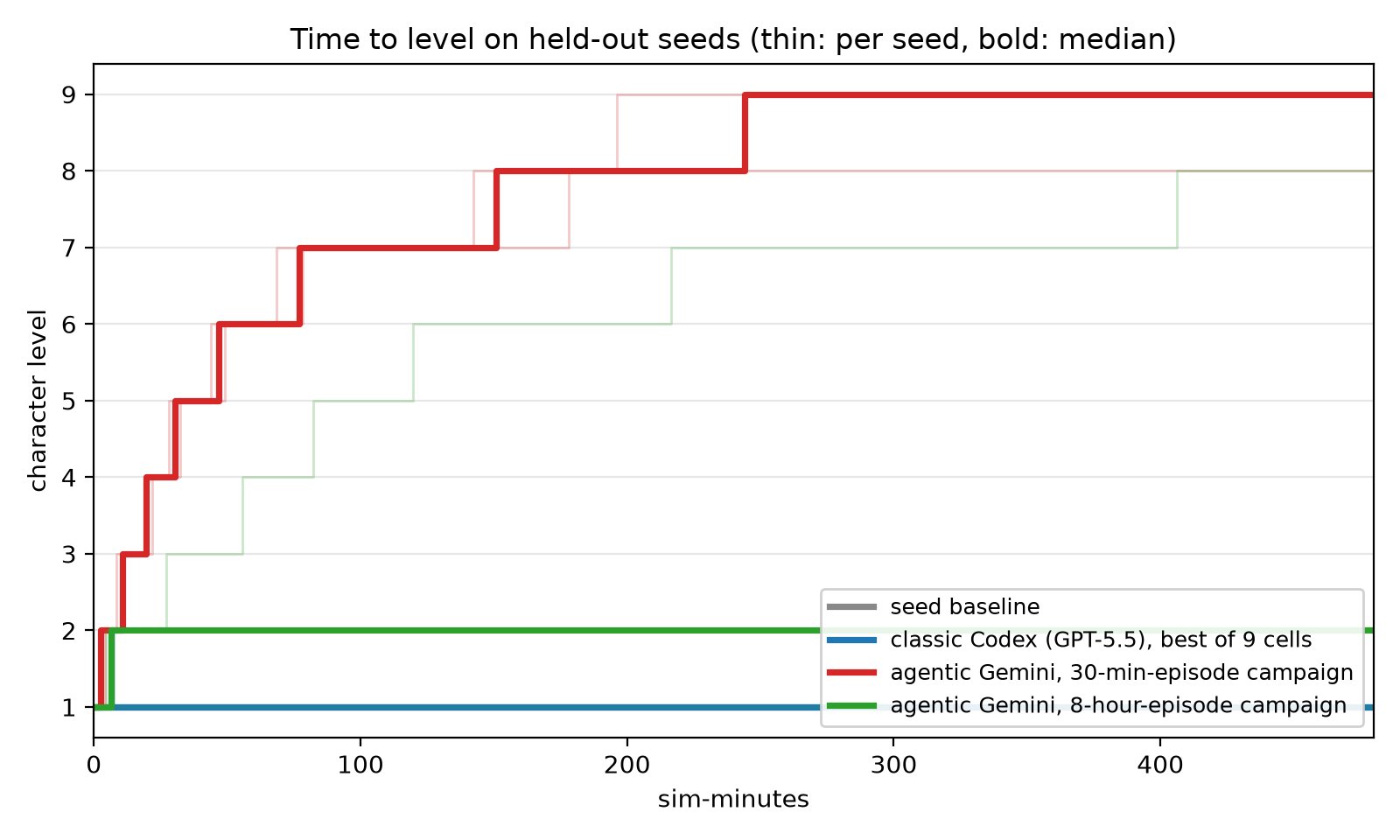
Eight-hour replays on the same unseen seeds. Red is the agentic policy: level 9 on two of three seeds and level 8 on the third. Green is a later run's champion, strong on one seed and weak on the others. The classic policies and the starting bot stay at levels 1 to 2.
With longer episodes and a better score (more on that below), the best run reached level 18 of 20 on unseen seeds after 39 hours of game time. It passed level 5 at 47 minutes, level 10 at 7.7 hours and level 15 at 23 hours. The other runs finished at levels 11 to 12. These policies die a lot, between 280 and 820 times per episode.
Result 3: one program runs five characters and clears the dungeon
This benchmark started from something that worked. Before it existed I ran a live autopilot on this game. Nobody flew the characters. Rules written as code chose every action 20 times a second, and a model set each character's plan every 8 to 20 seconds. Between runs a coding agent read the logs and rewrote the rules. That system cleared the Gravewyrm Sanctum over and over with a coordinated party in real time, looting included. The Sanctum is an elite dungeon that people group up for.
What the benchmark asks is stricter. The model gets a fixed budget of turns, one program has to run all five characters (tank, healer, mage, rogue, hunter), and the result only counts on seeds it has never seen.
The naive starting policy wipes after about two minutes.
In November I ran this track on a pinned build with Claude Opus 5.5 as the coding agent: 8 turns of 20 minutes, on a consumer subscription. I ran it twice, with different training seeds, in separate workspaces.
| Run 1 | Run 2 | |
|---|---|---|
| Starting policy on training seeds | 0 of 3 cleared | 0 of 3 cleared |
| After the first turn | 3 of 3 cleared | 3 of 3 cleared |
| Final policy, 5 unseen seeds | 5 of 5 cleared | 5 of 5 cleared |
| Mean clear time | 4.7 minutes | 6.1 minutes |
| Mean party deaths per clear | 0.6 | 0.6 |
| Wall time for the whole run | 54 minutes | 100 minutes |
Both final policies replay to the same scores, seed for seed. The two programs share about 2% of their text, and nothing in the second run's 407 tool calls touched the first run's folder, so these are two separate solutions.
The final boss on an unseen seed, in the game's real client. The panel on the left is the five characters. Every action comes from the one program the model wrote. Nobody is at the keyboard.
Here is the whole clear at three times speed:
The prompt is not blank. It gives the interface and a short section of general dungeon advice: pull one group at a time, let the warrior go first, the healer keeps people alive, damage dealers attack the tank's target. July's runs had the same advice and did not clear.
The program the model wrote is about 300 lines. It follows that advice where it holds and goes past it where its own test runs said otherwise:
- The tank pulls alone and everyone else trails well behind it. That part is the prompt's advice.
- After a pull the tank drags the enemies back to the party, away from the next group. The prompt says to fight where you stand.
- Before a boss or a pack of three it waits for full health. Before a single enemy it goes earlier.
- Food heals slower than standing still in this game, so the program never eats. The prompt suggests eating and drinking between pulls.
- The model found that under this interface the priest's heal only lands on the priest, because there is no action for targeting an ally. So the plan does not lean on a healer. The prompt says to heal the lowest member, which the interface cannot do. That is a flaw in my benchmark, and both runs found it.
- A spell that fails because a pillar blocks the line of sight gets a few tries, then the caster walks to the tank and tries from there. Without this the damage dealers stood idle on the last boss while the tank died.
- If the tank dies, the next living character takes over the pulls.
The first pull. One enemy, then the next.
Grand Necromancer Velkhar raises skeletons during the fight. The count under his name is how many enemies are on the party.
How much of this is the gear?
A lot of it. The benchmark gives the party the best gear available at level 20, which is the top level. I took the final policy from run 1 and weakened the party.
| Party | Unseen seeds cleared |
|---|---|
| Level 20, best gear (the benchmark's setup) | 5 of 5 |
| Level 20, no gear | 0 of 5 |
| Level 19, best gear | 1 of 5 |
| Level 18, best gear | 0 of 5 |
So this is the easiest version of the task, and the program has almost no margin. The gear alone still does not clear it: the starting policy has the same characters in the same gear and wipes every time. Level 19 and no gear are the next rungs, and nothing passes them yet.
What happened to the July runs
In July, Gemini 3.5 Flash ran this track three times. The record was one clear on one training seed and 0 of 9 on unseen seeds. When I went back in November I could not reproduce any of it. The built game from those runs was not kept. I rebuilt it from the committed code and replayed the stored policies: the starting policy reproduces exactly, and none of the six model-written policies matches its recorded score. So the July numbers are not in the table above, and I cannot compare the two models on this track. That is why the build is pinned now, with its hash stored beside every result.
Two more things to hold against the November result. It is one model. And the agent read some of the benchmark's own runner code outside its workspace, which I had told it not to do. It never touched the scorer or the results folder, but a clean rerun should lock that down.
Three times the benchmark was wrong
Each of these looked like the model failing. Each was my tooling.
| What broke | What it made me believe | What was true |
|---|---|---|
| Parsing the model's reply | "Gemini cannot write valid code" | The extractor missed code wrapped in JSON or fences. Fixed, it recovers 35 of 37 archived failures, and live compile failures drop to 4 of 60 and 0 of 60. |
| The score, XP divided by deaths | A policy "regressed" and was thrown away | It was the fastest leveler the benchmark had produced: level 4 on all three unseen seeds. Dying is cheap in this game, and the score punished the right strategy. The score is now lifetime XP, with deaths reported beside it. |
| Turn direction in the observation | Models "struggle with facing" | The sign was flipped against its own documentation for ten campaigns. Every policy steered against its compass. Rankings inside a campaign still hold, but every absolute score before the fix is too low. |
The habits I took from this: when everything fails at once, check the plumbing before believing the verdict. For any score, ask what a sensible agent would do that the score punishes. For any decoded observation, test the documented convention against the game.
What it cost
All of this ran on one laptop with consumer subscriptions or a metered key. The measured Gemini API bill for campaigns 4 to 6 together was 2 to 3 US dollars.
What this does not show
- It is one game, and the leveling runs are all one class, a solo hunter.
- The dungeon clears use the strongest party the game allows. One level lower, the same program fails.
- The dungeon track has one model on the pinned build, so it says nothing yet about which model writes the better program.
- The headline reversal is inside one model, with two or three runs per setup and results that swing a lot.
- The level 18 run changed the score and the episode length at the same time, so it is a record of what was reached and not evidence of why.
- Everything ran against local servers I control. The harness is not a tool for getting around a live game's rules on automation.
What I'd do next
- Run the agentic track with Codex and Claude. This is the biggest gap.
- Take the workbench apart one piece at a time to find which part matters. My guess is the quick evaluator, since removing it in a pilot let stuck-loop bugs ship in both turns.
- Run the dungeon track at level 19 and with no gear, where nothing clears yet, and with Codex and Gemini on the pinned build.